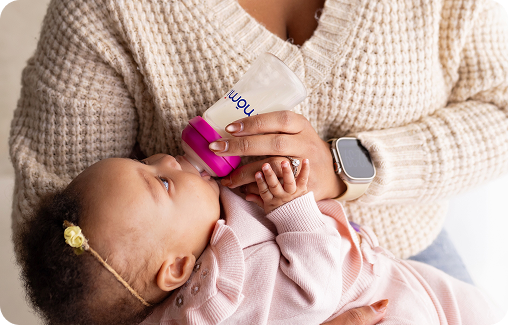

Infant feeding shouldn’t feel like rocket science, right?
But the truth is, many parents find it complicated and overwhelming. When bottle feedings are unregulated or unpaced, they can cause problems like gas, regurgitation, and breast refusal.
And that is the last thing a sleep-deprived, new parent needs!
The technique of paced bottle feeding helps address these problems, but requires some practice. Even then, practicing paced bottle feeding can stretch feedings out to 30 or more minutes.
The mōmi bottle has built-in paced feeding, allowing the baby to regulate the flow so you don't have to. With mōmi, infant feeding can be simple and easy, so you can trust any caregiver to bottle feed your baby.
understanding bottle feeding
A majority of babies both breast and bottle feed. For many moms and babies, switching from breast to bottle to breast again can be anxiety provoking and challenging.
Some babies may struggle with the mechanics of the different feeding modalities, (nursing vs. bottle feeding), and some may develop a preference for one over the other (which was once referred to as “nipple confusion,” but is now considered “nipple preference:” when baby begins to either refuse the breast or reject the bottle.
Other babies may suffer the side effects of unregulated feedings. (Projectile spit-ups!)
This is the reason mōmi created a bottle that is engineered to function like a breast: to simplify paced bottle feeding, prevent bottle-related discomfort and combat breast refusal.
what is paced bottle feeding?
Paced bottle feeding is a technique designed to mimic the natural rhythm of breastfeeding. Instead of milk flowing rapidly into the baby’s mouth, paced feeding slows the process down, allowing the baby to take breaks, breathe, and control how much they drink—just like they would at the breast. This method helps babies regulate their intake, prevents overfeeding, and supports a smoother transition back to the breast when mom is available or choosing to nurse.
Let’s look at why it is important to adopt paced feeding techniques with babies:
1. conventional bottles can cause overfeeding in infants
Unregulated or unpaced feeding with a conventional bottle can cause overfeeding, which then leads to problems like obesity, gas, and discomfort, and could mean sleepless nights for parents.
And while baby bottles may not look particularly complicated to adults, for an infant, they are a complete departure mechanically from nature’s design of nursing.
A traditional bottle-feeding technique takes away an infant’s ability to self-regulate during feeding. This is because conventional bottle nipples function differently than a human breast due to their hollow design, stiff material, and flow rate.
These fundamental properties of conventional bottle nipples require that babies adapt significantly: to the feel of rigid material in the mouth, to the faster flow of liquid, and to the oral mechanics required to stop the milk flow using the tongue.
When feeding from the breast, babies use innate oral mechanics to stretch and compress the naturally pliant maternal tissue while regulating the speed and volume of feeding through their own natural sucking/pausing patterns.
At the breast, babies are able to self-regulate the speed and volume of the feeding, thus avoiding overfeeding.
2. nursing allows babies to self-regulate feeding
During a nursing session, the baby is literally in control of the feeding.
However, when we use a conventional bottle, we take away this control, and the baby instead becomes a passive participant. Without control of the speed, milk can flow too quickly, which often results in choking and flooding of the mouth.
3. unpaced bottle feeding can lead to regurgitation and spit-up
Another reason experts recommend paced feeding techniques is that unpaced bottle feeding can lead the baby to unwillingly consume large volumes of milk. This can cause discomfort and lead to regurgitation or spitting-up.
Recurrent regurgitation leads to an increased risk of gastroesophageal reflux disease (GERD) or heartburn from stomach acid. That in turn can negatively affect the infant’s esophagus tissue - and waste precious breast milk.
4. conventional bottles can lead to breast refusal
Last but certainly not least, one of the most important reasons to consider paced feeding techniques is breast refusal. When babies have learned how easy it is to feed passively from a conventional bottle, they sometimes lose interest in the exercise of moral motor skills required by nursing.
what is the paced bottle feeding method?
The cons of conventional, unregulated bottle feeding have led to the development of paced feeding practices. But what exactly is it and how can you start?
Paced bottle feeding is a method that aims to return regulation to the infant by more closely mimicking the breast-feeding experience for the baby.
The goal is to slow the feeding pace. This technique reduces the risk of overfeeding and is recommended for all bottle-fed infants, whether or not they are also breastfed.
what does paced bottle feeding look like?
During paced bottle feeding, caregivers intentionally take breaks during the feeding and alter the feeding technique to engage the baby. They do this as they carefully watch the infant for signs of fullness or satiety. They also alter the traditional feeding position to slow the milk flow through the nipple.
In summary, paced bottle feeding involves holding the infant in a more upright position, keeping the bottle horizontal, and mindfully slowing the feeding speed. This also requires regular breaks from the feeding, as often as every 3–5 sips, and waiting for ongoing hunger cues to restart the feeding.
In order to focus on preserving nursing, some paced bottle-feeding experts also recommend shifting the infant’s position from one arm to the other, which mimics the shift in nursing from one breast to the other.
The objective of this technique is to slow down the process and allow the infant to learn fullness cues, which in turn helps them demonstrate satiety and stop feeding when full.
step-by-step paced feeding guide
Here’s a simple, caregiver-friendly guide to practicing paced feeding:
- Choose a slow-flow nipple: This prevents milk from flooding the baby’s mouth and encourages active sucking.
- Hold your baby in an upright or semi-upright position: A 45–60° angle helps with digestion and gives the baby better control.
- Keep the bottle in a horizontal position: This slows the flow of milk and encourages the baby to use active suction to feed.
- Let the baby latch onto the nipple themselves: This ensures baby is ready to work with the bottle nipple and supports self-regulation
- Offer 3–5 sucks, then pause: Gently tilt the bottle away from baby’s mouth during pauses so milk stops flowing. Resume when the baby re-engages.
- Watch for hunger and fullness cues: A hungry baby will remain oriented toward the bottle and should show signs of active feeding (jaw rocking, movement in their cheeks and throat). They may keep their hands up near their face. Babies show signs they are satiated by turning away from the bottle, pushing the nipple from their mouth, relaxing their bodies and moving their hands and arms downward.
- Switch sides halfway through the feeding: This mimics switching breasts and supports balanced neck muscle development.
common mistakes to avoid
Even well-intentioned caregivers can accidentally work against paced feeding—here are the most common pitfalls:
- Using a fast-flow nipple: This overwhelms babies and defeats the purpose of pacing.
- Tilting the bottle too high: A steep angle causes milk to pour into the mouth instead of allowing the baby to draw it out.
- Rushing the feeding: Trying to “finish the bottle quickly” can lead to overfeeding and discomfort.
- Feeding at the first sign of fussiness: Babies cry for many reasons, only one of which is hunger. Pausing to assess cues prevents unnecessary feeding.
- Not pausing during the feeding: Skipping pauses removes the baby’s chance to regulate their intake.
- Forcing the baby to finish the bottle: Babies know when they’re full. Allowing them to stop when they show signs of fullness will support healthy long-term eating habits.
not as easy as it looks: the cons of paced feeding
With a bit of practice, dedicated caregivers get the hang of paced bottle feeding.
One significant drawback is training all caregivers to use paced feeding techniques. This is especially tricky for parents who drop off infants at daycare or have caretakers for whom instruction and learning can be stressful and difficult to grasp.
mōmi lets the baby set the pace
But what if we could design a bottle with paced feeding built in?
That’s what mōmi’s goal was: to engineer a bottle not to look like a breast, but to function like one.With paced feeding automatically built in, the bottle and nipple system removes the challenges of paced feeding while providing all the benefits!
With its patented babypace® technology, the mōmi bottle returns the self-regulation of feedings to the infant without adding stress to the caregiver. The mōmi bottle’s patented design replicates the natural oral mechanics of nursing and allows infants to use their innate oral mechanics to regulate the speed and volume of feedings by responding to compression shutoff.
mōmi also took a few extra steps and made it even better by designing the nipple to be soft and stretchy, like human breast tissue. Its central duct can compress to 80% of its original diameter with less than 1 pound of force.
Why?
So that your baby can easily stop the flow of milk in the same way they do in nursing.
The active work of engaging in compression shutoff slows the feeding speed, tires the baby appropriately, develops oral muscle strength, and helps to avoid the overfeeding associated with passive traditional bottle feeding.
The mōmi bottle doesn’t just make paced bottle feeding a breeze, it also lets you focus on bonding and enjoying the feeding experience with your little one, just like the breast.
faqs
What exactly is paced bottle feeding?
Paced bottle feeding is a method that slows down the flow of milk from a bottle. It helps prevent overfeeding and digestive discomfort that results from feeding too quickly or too much..
Why is paced bottle feeding recommended for breastfed babies?
Because paced feeding mimics the flow and pauses of breastfeeding, it reduces the risk of nipple preference and makes it easier for babies to transition between breast and bottle without frustration or confusion.
Can paced bottle feeding help with gas, spit-up, or reflux?
Yes. Slowing down the feed reduces excess air intake and gives the baby more control, which often decreases spit-up, fussiness, gassiness, and reflux symptoms.
How often should I use paced bottle feeding?
Paced feeding should be used at every bottle feed, especially for young infants or babies switching between breast and bottle. As babies grow and gain stronger feeding coordination, you can adjust pacing based on their cues.